Designing Nighttime Landscapes on Black Paper
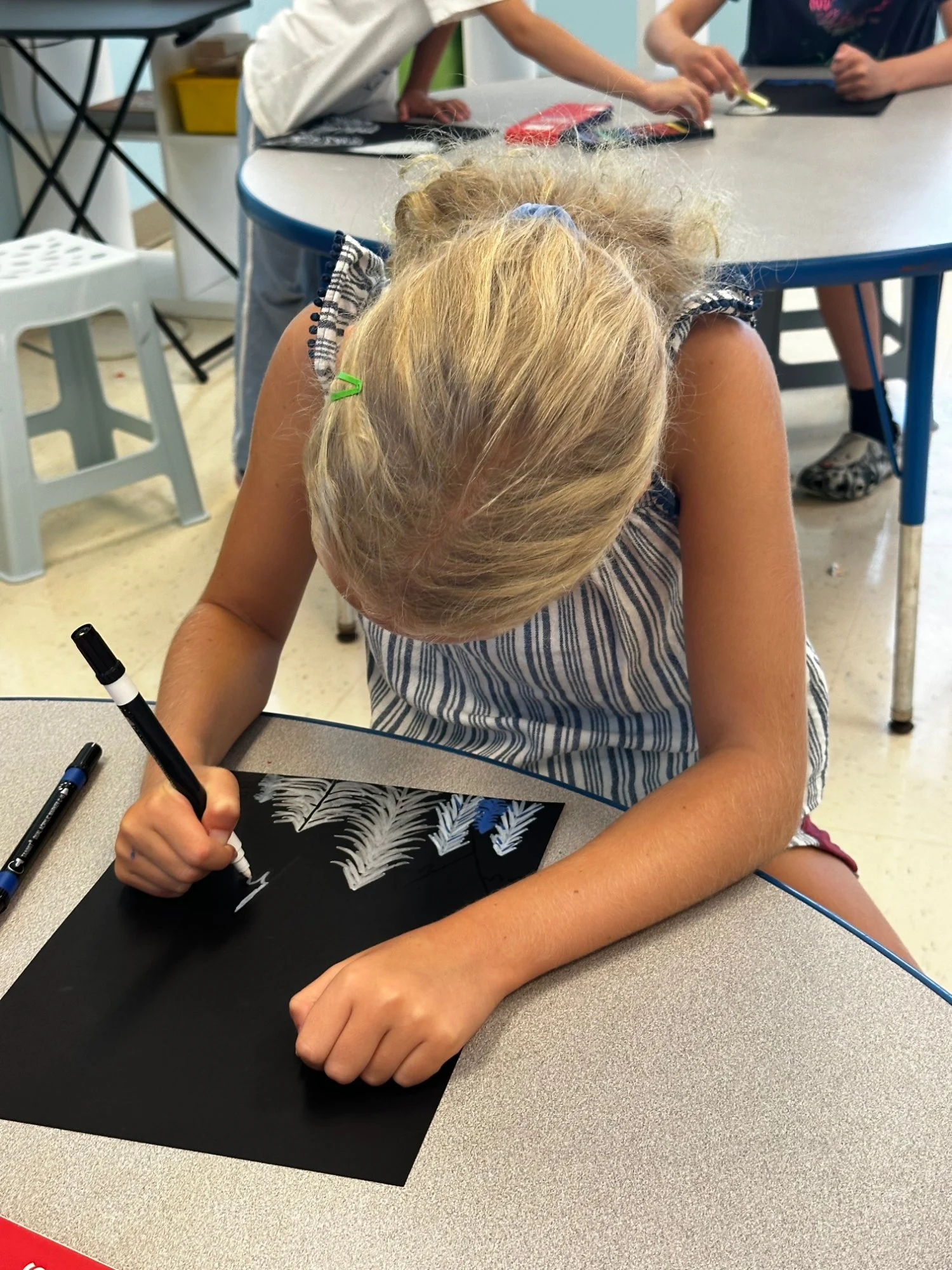
In our upper elementary and middle school art studio at Mindful Leaders Academy this week, students engaged in a dynamic visual arts project centered on nighttime landscapes. These compositions, referred to as nightscapes, began with a foundation of black paper. Choosing a dark working surface directly shifts the traditional artistic approach by requiring learners to build light and color out of darkness rather than layering shadows over white.
Working on black paper provides upper elementary and middle school students with an immediate study in value and opacity. In traditional drawing, white space provides natural highlights, but a dark foundation challenges students to consider how bright pigments interact with deep backgrounds. This practice encourages learners to carefully assess light sources, tonal depth, and atmospheric perspective. Through our dedicated visual arts program, students regularly engage with foundational concepts that encourage thoughtful planning and creative confidence.
For students in this age group, shifting artistic conventions helps refine abstract thinking. Developing a nightscape on dark paper asks learners to conceptualize illumination as an active addition to the page. This method supports spatial awareness and expands how young artists plan compositional balance across contrasting backgrounds.
Capturing the Northern Lights, Moon, and Starfield
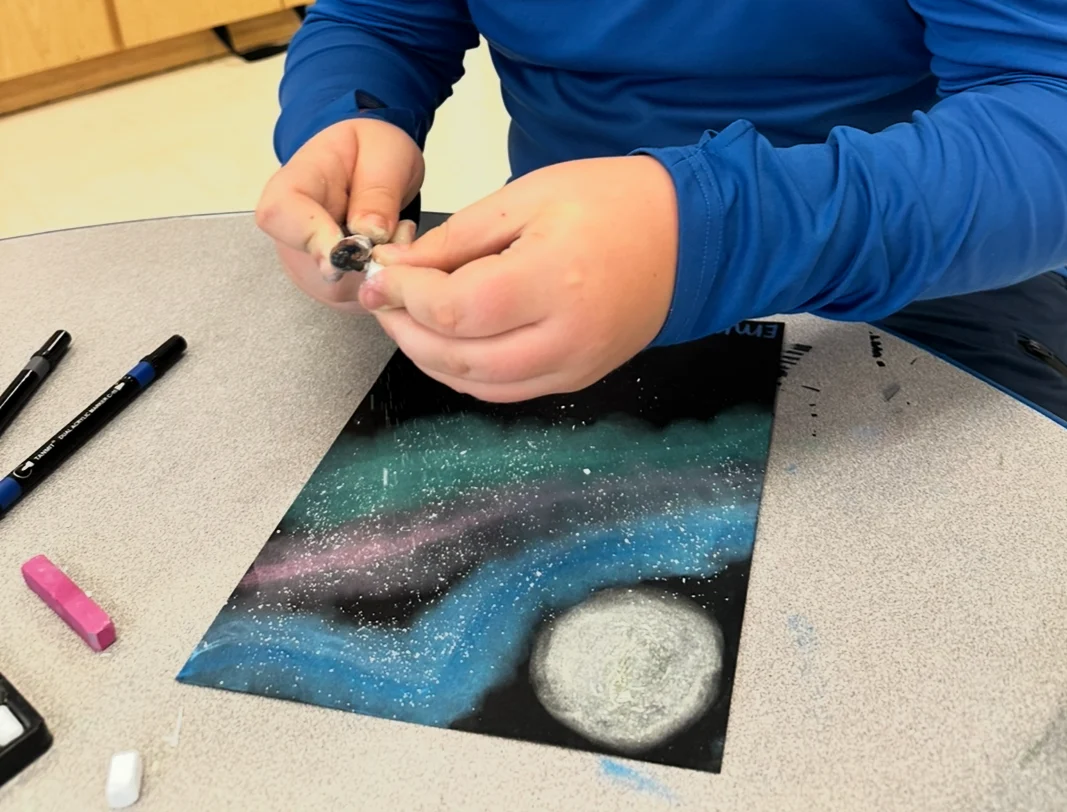
A central focus of the project was rendering the vibrant phenomenon of the aurora borealis, or northern lights, sweeping across the night sky. Students worked to create glowing atmospheric bands that illuminated their compositions alongside a prominent moon and scattered stars. Depicting celestial light sources against a dark horizon offered rich opportunities to examine how natural luminescence alters sky tones.
Exploring atmospheric subjects like the aurora connects visual expression with observational inquiry. Upper elementary and middle school students can deepen their understanding of light diffusion, color gradients, and celestial geometry as they translate natural phenomena onto paper. Balancing a prominent moon with delicate starfields offers practice in scaling focal points and maintaining visual harmony across an expansive background.
This thematic exploration encourages students to think critically about how light moves through natural environments. Families exploring our visual arts curriculum often appreciate how projects integrate observational techniques with creative interpretation, giving students room to experiment with expressive skies while refining their technical control.
Exploring Dual Mediums: Chalk Pastels and Acrylic Paint Markers
To bring these nightscapes to life, students explored two distinct artistic mediums: chalk pastels and acrylic paint markers. Combining these tools allowed learners to investigate how varying materials interact and how different mediums can be applied to construct specific elements of a unified piece of art.
Chalk pastels offer soft, blendable pigment that spreads smoothly across textured paper, making them well suited for diffuse visual effects like sweeping auroras and glowing moonlight. In contrast, acrylic paint markers provide dense, crisp, opaque lines that stand out sharply against both dark paper and powdery surfaces. Using these markers gives students precise control when detailing fine stars, lunar edges, or sharp contours.
Navigating two contrasting mediums teaches older elementary and middle school students material awareness. Young artists learn that specific tools serve distinct functions within a single composition. This dual-medium approach offers practice in selecting the appropriate medium for atmospheric gradients versus crisp illustrative details, strengthening deliberate decision-making in the creative process.
Blending Strategies and Layering Colors
Throughout the studio sessions, instruction covered specific blending strategies and methods for layering colors effectively. Working with pastels and markers requires an understanding of how pigments combine on the surface without muddying the overall composition.
Students investigated how gradual color transitions can create luminous gradients across the sky. Layering colors allows artists to establish rich undertones, shift values smoothly, and create the illusion of vibrant energy within the northern lights. Practicing controlled blending provides valuable fine-motor development, as students must regulate hand pressure, tool angles, and smudging techniques to achieve balanced saturation.
At this developmental stage, mastering blending and layering strategies fosters persistence and cognitive flexibility. Working through complex color transitions asks learners to evaluate their progress continuously, make adjustments, and refine surface layers until their desired tonal balance is achieved. These techniques form an essential part of the broader studio culture across our academy programs.
Creating Silhouette Effects and Contrast
Another key element of the nightscape project was learning how to create silhouette effects. By placing dark foreground elements against the glowing northern lights, moon, and stars, students explored how stark contrast can ground a landscape and generate dramatic visual depth.
Silhouettes require students to focus entirely on outline, proportion, and negative space rather than internal surface detail. Defining trees, landforms, or horizon contours against a bright sky teaches learners how clean edges communicate form and distance. This contrast establishes clear foreground, middle ground, and background layers within the composition.
Practicing silhouette techniques offers upper elementary and middle school students valuable practice in visual planning. Deciding where light should peak and where solid forms should anchor the page reinforces foundational design principles, including focal balance, scale, and graphic impact.
Reflecting on Hard Work and Artistic Growth
Our upper elementary and middle school students worked exceptionally hard on their nightscape projects, demonstrating focus, dedication, and attention to detail throughout the entire process. Ms. Meghan, Founder, and the studio staff shared genuine pride in how fantastically each student's artwork turned out.
At home, families may notice their children showing an increased interest in mixed-media experimentation, observing evening skies with greater attention to color gradients, or discussing how contrasting values affect visual presentations. These informal reflections represent natural extensions of the technical skills and design concepts practiced during studio time.
Engaging older elementary and middle school students in rigorous, multi-step artistic challenges nurtures creative problem-solving and self-expression. We invite interested families to book a tour to learn more about our comprehensive educational offerings and see our creative learning spaces in Lakewood Ranch.